Separate Screens, Separate Realities: How Platform Algorithms Are Quietly Dissolving Washington's Shared Civic Space

Photo: Doctorxgc, CC BY-SA 4.0, via Wikimedia Commons
On a Tuesday evening in late October, a Spokane Valley homeowner scrolled through Facebook and encountered a string of posts warning that a proposed King County housing density bill would eventually force "California-style zoning" onto eastern Washington communities. That same evening, a Bellingham renter opened TikTok and watched three consecutive short videos celebrating the same legislation as a long-overdue correction to a housing market that had priced out working families for a generation. Neither person was exposed to the other's version of events. Neither platform flagged the discrepancy. Both users walked away more certain of what they already believed.
This is not an accident. It is, in the language of the technology industry, a feature.
Across Washington state, the algorithmic architecture of social media platforms is systematically sorting residents into discrete information environments — curated feeds that reward emotional engagement, confirm existing beliefs, and steadily reduce exposure to competing perspectives. The consequences for civic life in a state already divided along sharp geographic, demographic, and partisan lines are difficult to overstate.
How the Sorting Mechanism Works
The core logic of engagement-based algorithms is straightforward: content that provokes strong reactions — outrage, enthusiasm, fear, tribal solidarity — generates more clicks, shares, and time-on-platform than content that is measured, ambiguous, or demanding of context. Platforms optimize relentlessly for that engagement, which means they systematically amplify the most emotionally charged version of any given story.
For political content, this dynamic has a predictable outcome. A nuanced analysis of Washington's capital gains tax structure generates modest interaction. A post declaring that the same tax is either "economic justice" or "an assault on small business owners" spreads rapidly through partisan networks. The algorithm does not evaluate accuracy. It measures heat.
Researchers at the University of Washington's Center for an Informed Public have documented how this process accelerates during election cycles, when the volume of politically coded content surges and the algorithmic premium on provocation intensifies. Their work has shown that misleading narratives about Washington ballot measures can circulate widely within specific demographic clusters for days before fact-checking resources — which reach a far smaller and already-skeptical audience — begin to circulate in response.
Politicians Who Have Learned to Play the Game
Washington elected officials across the political spectrum have adapted to the new media environment with varying degrees of deliberateness. Some have embraced platform-native communication strategies that, intentionally or not, reinforce the silo effect.
Several state legislators now maintain Facebook pages that function less as public information channels and more as closed-loop affirmation systems. Posts are crafted to generate strong in-group responses from existing supporters, rarely engaging with opposing viewpoints in substantive terms. Comment sections are moderated to remove dissent. The result is a digital constituency that receives a carefully managed version of the legislator's record, insulated from the friction of adversarial scrutiny.
On TikTok, younger candidates and political operatives have recognized that short-form video rewards performance over policy depth. A fifteen-second clip of a state representative delivering a punchy one-liner about a budget vote will outperform a five-minute explainer on the same vote by orders of magnitude. The incentive structure pushes political communication toward the declarative and away from the deliberative.
This is not purely a partisan phenomenon. Progressive advocacy groups in western Washington and conservative organizing networks in the eastern part of the state have both developed sophisticated content strategies designed to keep their respective audiences engaged and internally cohesive — strategies that depend, structurally, on minimizing exposure to the other side's arguments.
The Geography of Washington's Information Divide
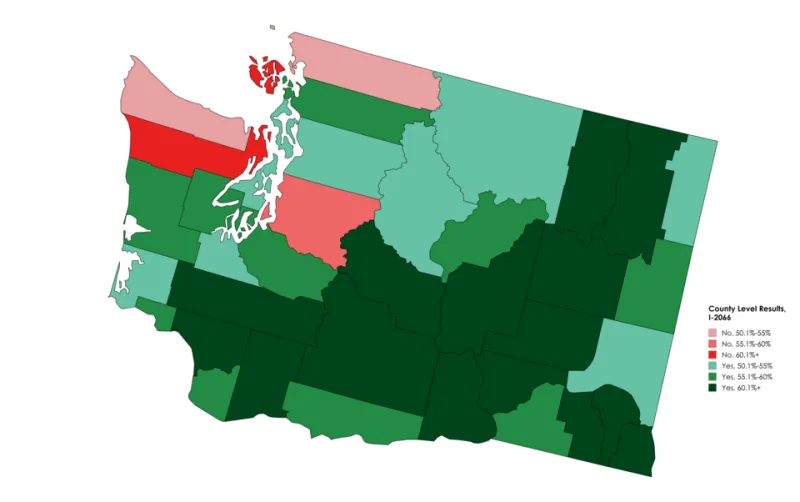
Washington's pre-existing geographic and cultural divisions make it particularly vulnerable to algorithmic fragmentation. The state encompasses one of the nation's most densely populated and economically dynamic metropolitan corridors alongside vast rural expanses where economic anxiety, distrust of urban institutions, and a distinct political identity have long defined community life.
When residents of Yakima and residents of Capitol Hill in Seattle encounter entirely different accounts of the same state legislative session — different protagonists, different villains, different stakes — the already-strained project of statewide democratic governance becomes harder. Compromise requires a baseline of shared facts. Legislation requires constituencies that understand, even if they oppose, what is being debated. Algorithmic curation is quietly dissolving that baseline.
Local journalism, historically the institution most responsible for maintaining a common factual record at the community level, has contracted sharply across Washington over the past two decades. Dozens of community newspapers have closed or reduced publication. The vacuum they left has been filled, unevenly and unreliably, by social media content — content whose selection and amplification is governed not by editorial judgment but by engagement metrics.
In smaller Washington cities and rural counties, where a single local newspaper once served as the primary shared information source for residents across partisan lines, Facebook groups have become the de facto public square. Those groups are algorithmically managed environments, not neutral forums. The platform's systems determine what each member sees, in what order, and with what emotional framing.
What Civic Institutions Are — and Aren't — Doing
Washington's Secretary of State's office has invested in voter education initiatives and maintains publicly accessible resources on ballot measures and candidate information. Nonpartisan civic organizations, including the League of Women Voters of Washington and various community foundation-backed media initiatives, have worked to expand access to reliable local election coverage.
These efforts are meaningful, but they operate at a significant structural disadvantage. Civic information resources compete for attention on the same platforms whose algorithms are calibrated to favor content that provokes rather than informs. A sober, well-sourced explainer on a state transportation levy does not generate the engagement signals that cause a platform to amplify it broadly. It reaches people who were already looking for it.
At the federal level, legislative efforts to impose transparency requirements on political advertising algorithms or mandate algorithmic audits have stalled repeatedly. Washington's congressional delegation has engaged the issue with varying degrees of urgency, but no comprehensive federal framework governing platform accountability for civic harm has advanced.
The Stakes for Democratic Participation
The concern is not simply that Washington residents disagree with one another — disagreement is democracy's raw material. The concern is that the disagreements are increasingly conducted across an epistemic gulf so wide that shared deliberation becomes functionally impossible. When two voters cannot agree on what happened in the last legislative session, let alone what it means, the machinery of representative government begins to seize.
Young voters, who disproportionately rely on social media as their primary news source, are particularly immersed in algorithmically curated environments. Research consistently shows that this cohort's news consumption is heavily mediated by platforms optimized for engagement, with limited exposure to the kind of sustained, contextual local reporting that builds civic literacy over time.
Washington has historically ranked among the more civically engaged states in the nation, with high voter participation rates and a robust tradition of direct democracy through the initiative process. Preserving that civic culture in an era of algorithmic fragmentation will require deliberate institutional investment — in local journalism, in digital media literacy education, and in honest public conversation about what the platforms are actually doing to the information environment that democracy runs on.
The algorithm does not vote. But it is increasingly deciding what voters know, what they fear, and whom they trust. In Washington, as elsewhere, that is a civic problem that will not resolve itself.