The Quiet Architects: How County Commissioners Are Reshaping Washington's Political Landscape From Below
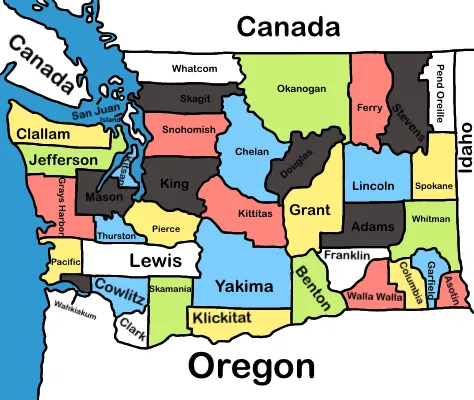
Photo: YeetTheDuck, CC BY-SA 4.0, via Wikimedia Commons
Every two years, Washington voters cast ballots for legislators, statewide executives, and occasionally members of Congress. Campaign coverage fills local newspapers and television broadcasts. Fundraising totals become news in themselves. Yet in county courthouses from Clallam to Asotin, a quieter and arguably more consequential form of governance unfolds largely beyond the reach of cameras, reporters, or significant campaign spending.
County commissioners—three in most of Washington's 39 counties, five in the state's most populous—exercise authority over decisions that touch residents' daily lives in immediate and lasting ways. They approve or deny development permits that determine where housing gets built. They set the budgets for sheriff's departments and prosecuting attorneys. They control public health departments that, as the COVID-19 pandemic demonstrated, can diverge sharply from state guidance with real consequences for local populations. And increasingly, they are doing all of this within a political environment that has grown more ideologically charged, more nationalized, and more consequential than at any point in recent memory.
Authority Without Accountability
The structural power of county commissioners is easy to underestimate precisely because it is so diffuse. Unlike a governor who signs or vetoes legislation, or a legislator whose floor votes appear in a public record, commissioners make decisions across dozens of domains simultaneously—land use planning, solid waste management, emergency services, mental health funding, and indigent defense, among others.
In Washington, counties serve as the administrative arm of state government in critical areas. When the state legislature passes a new behavioral health mandate, it is frequently county commissioners who determine how—and whether—that mandate is implemented locally. When state environmental regulations intersect with agricultural land use, county commissioners often serve as the first and most influential interpreters of what those rules mean in practice.
This layered authority creates what some policy analysts describe as a "policy translation" function. State law may set broad parameters, but county government fills in the details. The result is that two residents living in neighboring counties can experience dramatically different versions of the same state policy.
Underfunded Races, Oversized Stakes
Despite this breadth of authority, commissioner races remain among the most financially anemic in Washington's electoral landscape. A competitive state legislative race in a swing district might attract $500,000 or more in combined candidate and independent expenditure spending. A county commissioner race in a mid-sized county—one with genuine policy consequences for tens of thousands of residents—may see a fraction of that amount, sometimes operating on budgets measured in the low tens of thousands of dollars.
The funding disparity is not merely a curiosity. It has structural consequences. Candidates with fewer resources cannot communicate their positions to voters as effectively. Incumbents enjoy advantages that compound over time, insulating them from accountability even when their records warrant scrutiny. And the absence of robust campaign spending means that organized interests—agricultural associations, real estate developers, law enforcement unions—can exercise disproportionate influence at relatively low cost.
Local journalism, already diminished across much of Washington, rarely provides the sustained coverage that might compensate for low campaign visibility. In many rural counties, a single reporter may cover all of county government alongside school board meetings, crime reports, and community events. The depth of accountability reporting that commissioner races arguably deserve is simply not available in most jurisdictions.
Nationalization at the Local Level
Perhaps the most significant recent development in Washington's commissioner landscape is the degree to which national political currents have reshaped what were once relatively nonpartisan offices. In rural and exurban counties, commissioners have increasingly aligned with national conservative movements on issues ranging from Second Amendment sanctuary resolutions to resistance to state public health directives. In more urban counties, commissioners have moved in the opposite direction, using their platforms to advance progressive priorities on housing density, climate adaptation, and criminal justice reform.
This ideological sorting has made commissioner races more competitive in some respects—and more predictable in others. Counties that were once genuine swing jurisdictions have hardened into reliable partisan strongholds, reducing the incentive for either party to invest heavily in contested races. Meanwhile, the issues being decided at the county level have grown more politically loaded, with commissioners increasingly called upon to take positions on matters that carry explicit national political valence.
The implications for state policy are considerable. A governor or state agency seeking consistent implementation of a new initiative across Washington's 39 counties must now navigate a patchwork of commissioner boards with varying degrees of ideological alignment with state priorities. Resistance at the county level can slow, dilute, or effectively nullify policies that the legislature and executive branch have formally enacted.
The Public Health Precedent
No recent episode illustrated the stakes of county commissioner authority more clearly than the pandemic. When Governor Jay Inslee issued public health directives beginning in 2020, implementation fell substantially to county health departments—departments whose budgets, leadership structures, and political environments are shaped by county commissioners.
In several Eastern Washington counties, commissioners took active steps to signal skepticism of state mandates, creating political atmospheres in which local health officers faced intense pressure. Some resigned. Others moderated their public communications in ways that health advocates argued compromised the clarity of public guidance. The variation in outcomes across counties was not random; it tracked closely with the political postures of commissioner boards.
The pandemic experience served as an accelerated tutorial in the practical limits of state authority and the practical significance of county governance. For residents and policymakers alike, it raised questions that remain unresolved: How much policy divergence across counties is acceptable in a state that aspires to consistent standards? And who is responsible for ensuring that county officials are held accountable when their decisions have consequences that extend beyond their own jurisdictions?
Toward Greater Visibility
Addressing the accountability deficit in county commissioner governance does not require any single dramatic intervention. A combination of incremental changes could meaningfully improve the situation. Local news organizations, including nonprofit outlets, could prioritize sustained coverage of commissioner races and decisions as a matter of civic mission. Philanthropic funders interested in democratic health might direct resources specifically toward county-level accountability journalism.
Candidate filing and campaign finance reporting requirements, already in place through the Public Disclosure Commission, could be made more accessible to ordinary voters through improved digital interfaces. Civic organizations could develop voter guides specifically tailored to commissioner races, providing the kind of comparative candidate information that voters in higher-profile contests take for granted.
Perhaps most importantly, voters themselves can begin to reweight the significance they assign to these offices. The decisions made in county courthouses are not abstract or remote. They determine the character of local land use, the resources available to mental health services, the priorities of local law enforcement, and the practical implementation of state environmental and public health policy.
Washington's political future will not be written only in Olympia. It is being written, quietly and consequentially, in the meeting rooms of 39 county courthouses—and the degree to which that process is visible, contested, and accountable is very much a question of public will.