A Century of the Pump: Washington's Road Funding Model Is Running on Empty
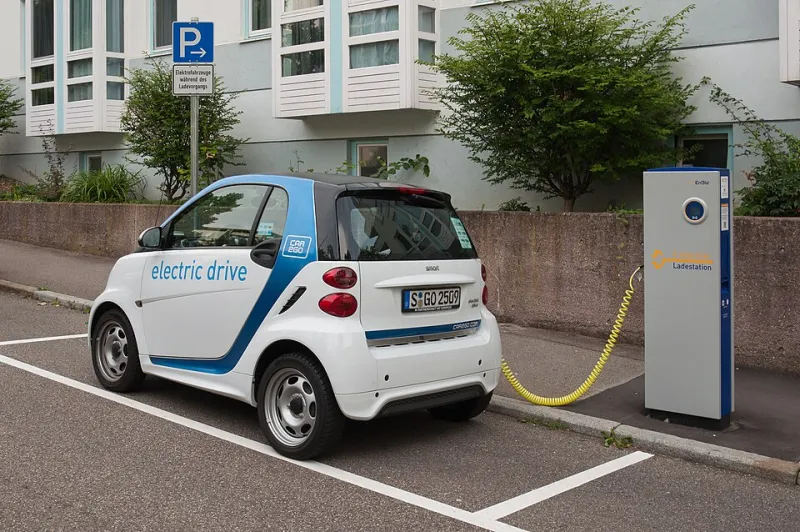
Photo: Julian Herzog (Website), CC BY 4.0, via Wikimedia Commons
Washington has a habit of forgetting its own boldest moments. One of them occurred in 1921, when the Legislature made this the first state in the union to tax gasoline for road purposes — a one-cent-per-gallon levy that would become the template for a funding model adopted by every state in the country.
That model is now failing. Not gradually, not theoretically, but measurably and on a schedule everyone in Olympia can read. The question is whether this state, which invented the fuel tax, has the ambition to invent what replaces it.
Why the Model Worked for a Hundred Years
The genius of the gas tax was its simplicity. It charged road users in rough proportion to road use, it collected itself at the pump, and it required no administration beyond a modest compliance apparatus. Every mile driven was, in effect, a small contribution to the maintenance of the roads driven on. For a century, the fuel tax was as close as public finance gets to a self-executing idea.
Three Forces Broke It
First, the electric vehicle. Every EV on Washington's roads is a car that consumes pavement but no gasoline, a free rider in a system built on the assumption that consumption and contribution travel together. The flat annual EV registration fee currently charged is a stopgap that undercollects from efficient vehicles and overcharges light ones.
Second, the changing commuter. Remote and hybrid work arrangements, accelerated by the pandemic, mean fewer gallons purchased even as total vehicle miles in the state have not declined proportionally. Fuel efficiency standards compound the problem: a modern fleet raises the same revenue per mile at half the tax rate of a 1980 fleet.
Third, the politics. Major transportation packages in Olympia have become decade-scale events, each one a negotiation over projects as much as principles, each one arriving later and costing more than the last. A revenue system that requires a generational legislative summit to adjust is not a system. It is a habit.
What a Serious Overhaul Looks Like
The honest answer is road-user charging: a per-mile fee that replaces the per-gallon tax, treating a mile of road use the same regardless of what fuels the vehicle. Washington has actually piloted this more seriously than almost any state — a multi-phase research program has tested odometer-based and GPS-based collection with thousands of volunteer drivers. The technology question is settled. The political question is not.
The objections deserve engagement, not dismissal. Privacy concerns about location tracking are legitimate, and the answer is to mandate distance-only reporting options — odometer readings, annual verification — as the default, not the exception. Equity concerns deserve real analysis: a per-mile charge assessed on all users, including the EV owners currently underpaying, is arguably fairer than a tax that penalizes those who can least afford efficient vehicles.
The transition should be gradual and honest: per-mile charges phased in as the gas tax phases down, with rural and low-income drivers protected during the crossover years.
The 1921 Standard
The legislators who passed the nation's first gas tax did something harder than raise a tax. They designed a mechanism. They matched a funding instrument to a technological reality — the automobile — and in doing so built the financial foundation of the modern state highway system.
Their successors in Olympia have spent a decade treating the fuel tax as a monument to be defended rather than a machine to be maintained. Monuments don't patch potholes. A state that was first in the nation a century ago has no business being last in line now. The invention is sitting there, piloted and proven. All that's missing is the nerve to pass it.